
Bubble: Quick Guide to the Chinese Fixed-Income Market
- 82newsbulletin
- Jan 18, 2021
- 3 min read
Written by Victoria Ni Mingyang
Today I will write about the current controversies in the Fixed Income industry (FI). For those of you who are not studying Finance, don’t worry, let’s break this down step by step.

Introduction
Fixed income is a financial product that is traded in the market, just like stocks. But unlike stocks, the fixed income market is not open to the general public.
There are many reasons why people want to buy Fixed incomes (bonds in this context). The main feature of debt product is that it pays a stable coupon (like a pre-determined interest rate) periodically. Companies that seek an alternative to equities may look for bonds to mitigate their total portfolio risks.
Many players can issue bonds, such as corporates, banks, real estates and the governments. A rating agency would give their bonds a ‘grade’ base on many factors. Usually, we generalise the bonds into Investment Grade and High Yield. Investment grades are the ones with relatively lower risks and lower returns, whereas High Yields are the opposite.

China
As Coronavirus hit the world, corporates struggled to maintain business. The macroeconomic climate is going downwards, while monetary incentives stay strong. Countries that recover from the virus hit tend to perform much better in Fixed-income markets, as seen in China, Vietnam, and Indonesia.
Many players invested heavily in Chinese corporate bonds, with the expectation that the Chinese economy will recover rapidly so the firms can outperform their previous quarter’s mark. The Fixed income investment from oversea to China has reached a record high at the end of 2020.
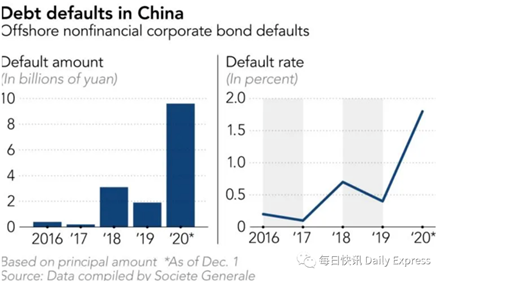
However, many well-known corporates in China defaulted. The famous Tsinghua-University-backed chip maker Tsinghua UniGroup’s failure to repay principal or interest on outstanding bonds has sent this year's default total to a record $25 billion. This raised concerns of a looming debt crisis that could derail China's post-pandemic recovery.
It is always a phenomenon that the Chinese government would bail out these companies when they get into trouble, given their political importance and symbolic image. However, the government seemed to be reluctant to save them. Soon after, many issuers defaulted, including several state-backed entities.
Source: https://www.bloomberg.com/news/articles/2021-01-04/china-makes-rating-firm-pay-for-corporate-fraud-for-first-time
Future?
Weeks after the Tsinghua UniGroup default, a local court in Hangzhou ruled that a very famous local rating firm (Dagong Global) should help compensate some creditors for a construction firm’s 1.4 billion yuan ($216 million) bond defaults three years ago. Dagong is responsible for repaying up to 10% of at least 494 million yuan of combined debt claims to more than 400 individual bondholders.
According to Bloomberg, China’s domestic rating firms have long been criticized for issuing inflated grades and being slow to detect risk in borrowers, one of the key factors that have capped global investors’ demand for the nation’s local corporate bonds. The authorities have sought to address such concerns in the past two years by allowing S&P Global Inc. and Fitch Ratings Inc. to operate independently in China, but with limited success so far.
Read more at:
DISCLAIMER: The contents of this website are solely owned by the author of each article and does not represent the views of the Awareness Committee or the Editorial team.


Comments