
Inflation is dead, long live inflation?
- Nicolas Guignard
- Feb 15, 2021
- 7 min read

In the West, the economic phenomenon had practically disappeared in the aftermath of the Voelker shock and the Great Financial Crisis. Could (almost) unprecedented government spending, struggling firms and high saving rates change that?
What do high levels of government debt, low policy rates, and new stock market highs all have in common? They are all linked to the era of quasi non-existent inflation which much of the western world is currently living in. Japan and the EU are struggling to contain deflation, while the USA has broken Kaldor’s magical square experiencing virtual full employment, high growth and low inflation. The apparent disappearance of inflation has puzzled economists for the past decade. However, in the wake of the pandemic, many fear it may return.
But first, what exactly is inflation, and why does it matter?
Inflation is defined as the decline of the purchasing power of a given currency over time, or as a general rise in the price level over time. To put it simply, a dollar today is worth more than a dollar tomorrow, and this independently of any successful investment you may pull off between today and tomorrow. Indeed, if an economy experiences inflation, then prices will increase and you will be able to purchase less with that same dollar after some time.
Let us take a very simple example: say that as of 2020, $60 would buy you 6 liters of milk. Then, a liter of milk costs $10. If throughout 2020, this economy experiences a 20% rate of inflation, then in 2021, a liter of mil will be worth $10 * 1.2 = 12. Then, with the same $60, you can buy 60 / 12 = 5 liters of milk. Your dollar today is therefore worth more than your dollar tomorrow as it would buy you less milk.
We can therefore see the obvious problem of inflation: it harms savers. Indeed, if the deposit rate is below that of inflation, then savers will lose money on their deposit, and will have little incentive to save. However, savings and investments (the money that is not used for consumption) are key to the long term growth of an economy. Inflation therefore needs to be kept in check, as it can harm economic prospects. Former British Prime Minister Margaret Thatcher would even claim in a 1974 speech: “Inflation is threatening to destroy our society. It is threatening to destroy not just the relative prosperity to which most of us have become accustomed, but the savings and plans of each person and family and the working capital of each business and other organization. The distress and unemployment that will follow unless the trend is stopped will be catastrophic.”
Inflation is normally caused by a mismatch between supply and demand. Indeed, basic economics dictates that a demand surplus will lead to an increase in the price of a commodity until a new equilibrium price is reached. Periods of high economic growth should therefore lead to inflation, while recessions trigger inflation to decrease, or even deflation (a decrease) in the price level).
Here, a last definition needs to be tackled before delving further into the inflationist prospects: the difference between a nominal and a real rate. When observing the evolution of a variable over time, economists use two different rates. The nominal rate is simply the rate at which the variable changes, while the real one is adjusted to account for the inflation that occurred over the period. Formally, Fisher’s formula states: (1+i) = (1+r)(1+π), with i as the nominal rate, r as the real one, and π as the inflation rate. An widely used approximation states that i = r + π as the remainder of the product nears 0. The image belows shows the difference in the US’ real (adjusted for 2005) and nominal GDP over time. We can see using one or the other variable can yield a significant difference.

The US's GDP in nominal vs real terms
Inflation matters so much to economists because of the way it relates to other economic variables, namely unemployment, growth, and external trade. The Briton Nicholas Kaldor created a ‘magical square’ in his famous 1971 Conflict in National Economic Objectives, where he showed how a government could only pursue some out of several desirable economic objectives. For example, sustaining high growth and maintaining low inflation could, in his view, not be achieved, while attaining full employment and maintaining an export surplus was also impossible.

Kaldor's magical square
Neo-Zelander economist Phillips found empirical evidence of this relationship while researching what would later be known as the Philipps curve: the relationship between an economy’s rate of employment and its rate of inflation. The closer to full employment a country is, the higher its rate of inflation. This makes sense, as the more individuals are employed, the more consumption increases and the more demand outclasses offer, therefore creating inflation.

Inflation was therefore seen, for much of the second half of the twentieth century, as an unavoidable byproduct of growth, a necessary evil. However, all inflation is not necessarily bad. Central banks aim at maintaining inflation around 2% a year, for two main reasons. First, maintaining some inflation allows to push individuals to consume rather than save all of their earnings, which is beneficial to short term growth. Second, inflation is largely preferred to deflation, and maintaining inflation around 2% allows for some leeway before reaching the critical 0% bound.
A short history of inflation in the western world
Economists only started measuring inflation after the beginning of the industrial revolution, and it has only been carefully examined after World War II. What should be remembered, is that in the aftermath of world war II, as much of the western world experienced their post-war economic miracle, they also experienced moderately high inflation.
Through the 1970’s, inflation reached new highs under the pressure from the twin 1973 and 1978 oil shocks which brought western economies to their knees. This can very clearly be seen in the charts below. However, in 1979, the US president Jimmy Carter appointed Paul Volcker as the Chairman of the FED. Volcker raised the FED’s policy rate to 20%, inflicting a harsh recession on the US, but effectively bringing inflation under control.
During the Great Moderation, inflation remained under control, but in the aftermath of the Great Financial Crisis, it nearly disappeared in the US. In other economies such as Japan or Germany, it remained even weaker as those states had to battle with deflation while their central banks pursued expansionary monetary policies to try and trigger inflation increase again.

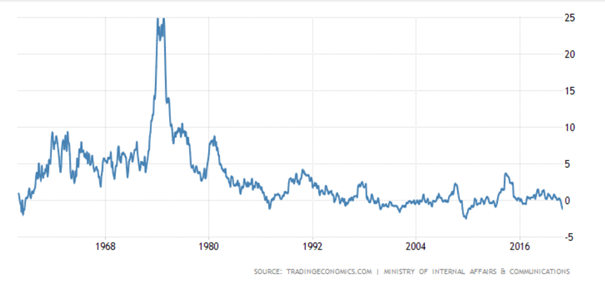
German inflation over time (1954-2020)
What must be remembered from this section is inflation was defeated, becoming, in much of the western world, a mere bad memory of ancient times when life was not as easy. Some warned, as stimulus packaged unfolded in 2008, that inflation may return. They were wrong, and in any case not listened to. The situation is however, very different today, and inflation may very well return in the aftermath of a unique crisis.
Inflation strikes back ?
The problem if inflation returns now, is that governments have borrowed huge sums of money, issuing bonds with short term maturities. This is sustainable as long as the interest rate does not change, which would certainly not be the case if inflation returns.
Several factors point out to a possible return of inflation. One such argument to explain that inflation may return is the high savings rate and increase in debt in much of the developed world. Once sanitary measures will be abandoned, consumers will have an excess of money to spend, while most firms will still be in the early stage of recovery. Demand will shoot up while the offer struggles to keep the pace, leading to a burst of inflation.
However, other more structural factors point to a possible return of inflation. In the aftermath of the collapse of Bretton Woods, a new wave of globalization started, which lavished the world with millions of workers. From the opening-up of China to the integration of eastern europe into the EU, the western world was faced with abundant, cheap labour. This is clearly not the case anymore, and the effect of the integration of those workers has been fully accounted for. Falling birth rates and decreasing working-age population may very well create a shortage of labour force in the West, which could trigger a rebound of inflation.
The second argument is less evident. Traditionally, central banks must serve a dual mandate (that of maximum employment and stable prices), which as seen before, consists of a set of contradictory goals. Much of the job of a central banker is therefore to balance between the two. With the disappearance of inflation and the destruction of the economy by the raging pandemics, it appears obvious that central bankers will shift their efforts to attain the former of the two goals. This opens the door to further injections of liquidities, negative interest rates and other such measures which will favour the return of inflation. Fiscal stimulus and accommodative monetary policies are necessary to support the struggling economy, however governments should ensure themselves against the return of inflation which could drastically increase the weight of the debt burden they have taken.
Indeed, central banks policy rates are typically correlated with inflation rates. If the real rate is too low, there will be no incentive to save which is terrible for an economy. Should inflation return, central banks would be forced to raise their policy rate, which in turn would increase the yield on government bonds, inflating the amount of money they must repay. Furthermore, most governments have tried and benefit from the historically low short term interest rates, by issuing short term bonds. This means that they are highly exposed to variation in the policy rate in the next years. Besides, low interest rates should theoretically have led to an increase of inflation, however, in the West, the relationship between the policy rate and the rate of inflation has largely been weakened since the Reagan era, possibly because of stagnant wages. The recent sharp cuts in interest rates around the world could therefore have the consequence of bringing back inflation if that relationship begins functioning the way economists expect it to again.
We saw that in January, after five months of deflation, inflation has returned to reach 0.9% inside of the European Union. This is mostly due to a surge in oil prices, and consists more of a temporary surge of inflation, and 0.9% is far from a worrying level. However, it does show that inflation could return. 2020 showed the world it should not underestimate black swan events, and governments should learn their lesson.
Further Readings:
Dec 10th, 2020 issue of The Economist
DISCLAIMER: The contents of this website are solely owned by the author of each article and does not represent the views of the Awareness Committee or the Editorial team.


Comments